Jeremy O’Donoghue, the ambitious principal of a steel framing start-up company in Western Australia, is working to future-proof his business.
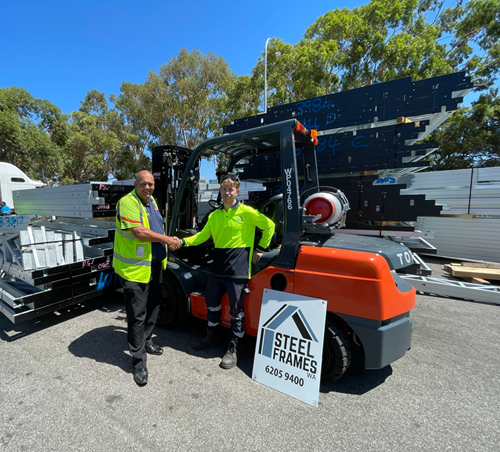
He has just taken delivery of two top-end Toyota 8-series forklifts to carry him safely and securely into the next phase of his development.
But as importantly, to create his own pathway to success, he’s adopted the “Toyota Way”, Toyota’s freely available guide to good manufacturing and business practice.
The internationally acclaimed Toyota Way focuses on continuous improvement in manufacturing processes and in ongoing respect for human resources.
“Toyota is the most successful manufacturer in the world, with the most in-demand reliable products, “Jeremy, owner in succession of five LandCruisers, said.
“It makes sense to learn from them.”
Jeremy started Steel Frames Western Australia four years ago after working for two of the state’s largest building companies.
The then 37-year-old identified a market niche in the economic production of durable, long-lasting, top-quality steel frame structures that could be precisely engineered for individual requirement.
He secured and redeveloped a factory building in Wangara, a light industrial suburb 20 km north of Perth’s central business district, “doing a lot of the reclamation myself, including building the fences.”
He used long-standing industry contacts to source steel from five suppliers brought to his factory either as coils to be roll formed or as structural steel to be cut to size according to in-house CAD cam design.
Jeremy’s natural forte is sales, and he developed a strong website and social platform to assist his own enthusiastic business gathering skills.
The Achilles’ heel in his company’s progress was the pair of competitor forklifts he initially brought as a matter of start-up economy.
“Steel frame production requires very precise handling, “he said. “Breakdown in the delivery process can have a cascading effect on manufacturing efficiency.”
When he suffered one forklift failure too many, he called on Toyota Material Handling Australia (TMHA), which loaned him a machine until his order for two new Toyota 8FGJ35 forklifts could be made.
“Our process demands a great deal of flexibility in the transport of steel of size and weight, “Jeremy said.
“Trusses can be 14 metres long; walls can be 3.5 metres square; deliveries of coils and structural steel are not palletised.
“We needed the ability to efficiently and safely lift up to 2.7 tonnes.”
TMHA worked with Steel Frames WA to specify machine capacity, tine size, travel, and load handling performance, and particularly top-class stability, a major requirement of Jeremy’s to ensure workplace safety.
The company settled on its top-of-the-line 8-series ‘8FGJ35 with a 3.5 tonne load capacity to accommodate variance in Steel Frame WA’s manufacturing parameters.
TMHA arranged on-site operator training, service scheduling, and lease financing through Toyota Finance Australia.
The Toyota Way, a development of the Toyota Production System regarded as the world’s best practice, has been freely shared by Toyota to assist companies, governments, and even organisations not involved in manufacturing, like retail, streamline their delivery.
Its fourteen key principles empower all team members in the manufacturing and delivery process to continually improve through the adoption of sound principles like muri, muda, and mura.
Muri is the avoidance of overburdening both people and equipment; muda minimises waste, and mura avoids uneven production levels.
“I’d been aware of the Toyota Way for years, but now it’s so logical to put it into practice, “Jeremy said.
“The framing market is a tough business with low margins, so we’re appreciative of every edge we can get.”